

It is visible from the log that the change of the active Setup occurs simultaneously with the change of the Throttle value.
This is the case if the switch used for changing the active Setup memory is not a switch dedicated solely to this function, but is the same switch also used for changes from Normal to Idle Up1 and Idle Up2.
It is therefore much more likely that it is not the stup3 settings that cause the vibrations but the increased rotor speed (RPM) that causes the elevator oscillations.
From the Flight Log, it can be seen that when Idle Up2 is activated (governor Speed 3 = 2250rpm) only the oscillations of the ‘ElevatorOut’ signal increase, there is no increase in the oscillations of the ‘AileronOut’ and ‘TailOut’ signals. Furthermore, there is a significant increase in vibration at the main rotor rotation speed, but no increase in the tail and motor rotation speeds. In addition, a drop in supply voltage occurs.
In this case, it is difficult to attempt to make a diagnosis without having the model in hand and being able to check its correct assembly and settings.
Having to rely only on the logs, we can only ask ourselves one question:
What could cause the increase in RPM to cause an increase in oscillations only in the X-axis with a frequency corresponding to the main rotor's rotational speed and a simultaneous increase in absorption causing a drop in voltage?
If it were a problem in the main rotor head, there should also be oscillations in the aileron Y axis, but there are not. This could mean that there is no problem in the main rotor but the oscillations may not appear on the Y-axis due to the different masses and weights and PID filtering on the aileron axis compared to the model's elevator axis. So we cannot 100% rule out that there may be problems in the rotor.
The only two most logical and obvious answers that come naturally to us are:
1) Mounting or adjustment problems with the tail drive belt which could be:
a) Twisted on itself and the teeth of the advancing belt interfere against the teeth of the retreating belt.
b) Too loose and the unstretched branch of the belt dances inside the tail boom causing temporary engagement of the advancing teeth against the retracting teeth.
2) Tail balance problems causing the tail to oscillate up and down at a frequency multiple of the rotor's rotational frequency (but at 2250rpm the tail frequency vibrations do not seem to increase). In flight with IdleUp2 (2250rpm) do you see the tail starting to swing up and down?
By the way, the RPM curve is never constant and stable even when the throttle value is constant. Is the engine carburation correct and not too lean or too fat? Is the engine not too hot or too cold? Is the mixture flow constant? Is the percentage of Nitro used sufficient (30%?). Is the glow plug temperature as stated by the manufacturer?
In the graph you sent, the noise in the ServoVoltage does not seem to decrease only and always when you use the Speed3:
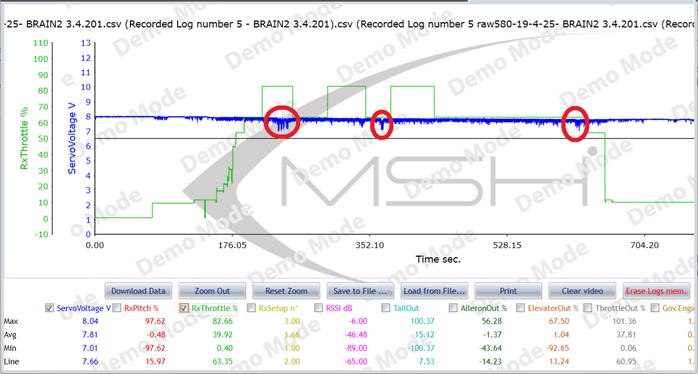
In panel 1 of the Wizard, in the ‘Power Supply Type’ dropdown, you have left ‘Unlisted’ and it doesn't seem to us that you have ever explained what you use to power the servos, the receiver and the flight controller.
A 2S lipo? If so, what is the mA rating and how many ‘C's’ does the Lipo pack have? Does the Lipo pack have two outputs and have you connected them both to the flight controller? Have you by any chance inserted a switch between the battery and the flight controller, or do you just use connectors (what type and current rating?) that you connect and disconnect?
Or do you use a BEC powered by a Lipo pack with more than 2S? If so, what brand and model of BEC do you use?
Regarding the voltage remaining low at power on for a few seconds (~15/16 seconds) this could be normal if you don't have a voltage stabilisation system and if the KST servos you are using draw more current at start up during their initialisation as some servos do.
However, as we have already said, in this case, it is difficult to attempt to make a diagnosis without having the model in hand and being able to check its correct assembly and settings. There is a risk of giving irrelevant information and not seeing other possible causes of the problem.